How to Reduce Leash Pulling Without Corrections
Dogs pull because pulling works, so the fix is making a loose leash the thing that pays.
October 6, 2026 · 4 min read
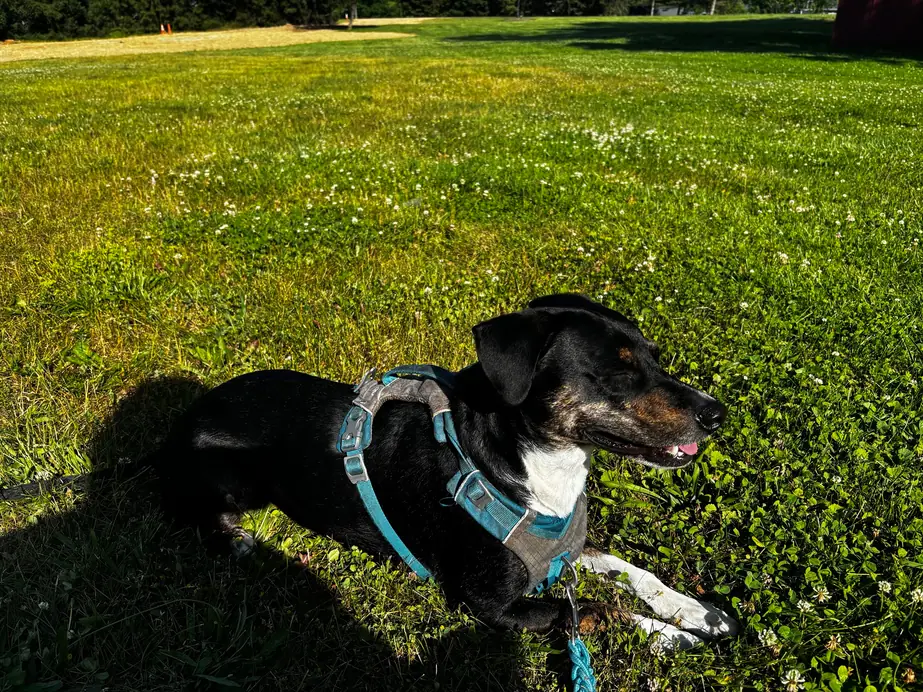
If a ten-minute walk around the block leaves your shoulder sore and your dog hoarse from straining, you're in good company. Leash pulling is one of the everyday problems Echo Dogs Training works on with Chester County owners, and it's very fixable. It takes a clear plan and a few weeks of short, boring, repeatable practice.
Why dogs pull
Dogs pull because it works. Your dog wants to reach the mailbox, the squirrel, the neighbor's hedge. When they lean into the leash and you keep walking, they get there. Every step that ends at something interesting teaches them that a tight leash means progress.
Speed plays a part too. Most dogs naturally move faster than a person strolling, and you're asking them to crawl past the best smells in the neighborhood. Pulling isn't stubbornness or a power struggle. It's a dog doing the obvious thing without better instructions.
That's why we don't use choke chains, prong collars or e-collars. Jerking a dog back tells them what not to do and nothing about what to do instead. Force-free training flips that: you show the dog exactly where to be, and you pay them for being there.
Pick your gear first
A flat collar or a well-fitted harness both work for training. A back-clip harness is comfortable and simple, though some dogs learn to lean into it and pull harder. A front-clip harness attaches at the chest, so a pulling dog gets turned gently back toward you, which makes pulling less rewarding. Neither one fixes the habit by itself. Choose what fits without rubbing and pair it with a regular six-foot leash. Skip retractable leashes while you're training, because they teach the dog that pulling makes the leash longer.
If your dog suddenly starts pulling much harder than usual, coughs on the leash, or seems sore when you clip on, check with your vet before you blame training.
Teach the marker and the reward position
Pick a marker: a short word like 'Yes' or a clicker. The marker means one thing: a treat is coming. Spend a few minutes in a quiet room saying the marker, then delivering a treat, until your dog's head swings toward you the instant they hear it.
Next, choose where treats get delivered. Feed at your leg, low, on the side you want your dog walking. That spot becomes the best real estate on the walk. Dogs repeat what pays, so a dog paid at your knee keeps coming back to your knee.
- Start in a hallway or room with the leash loose and your dog beside you.
- Mark the moment your dog's shoulder is level with your leg.
- Deliver the treat right at your leg, so your dog doesn't have to turn around or reach forward for it.
- Take two steps. Mark and feed again if the leash stays loose.
- Build up slowly: three steps, five steps, ten. Then add a turn.
- Move the same game to the backyard, then the driveway, then the sidewalk.
Stop and wait
On real walks, the leash will go tight. When it does, stop. Stand still like a tree. No yanking, no scolding, no extra talking. The moment your dog turns back toward you or the leash slackens, mark, feed at your leg, and start walking again.
Your dog learns a simple rule. A tight leash means we stop. A loose leash means we go. Forward motion is the real prize, which is why this works better than most treats.
Expect early walks to be slow. Covering one block in ten minutes is normal. If your dog is too wound up to respond to stopping, turn and walk the other way instead. Mark when they catch up and are back at your side. Direction changes keep you moving without rewarding the pull.
Set your dog up to succeed
Practice where it's easy before you ask for it where it's hard. A quiet street beats a busy trail. If your dog is bouncing off the walls at the front door, wait at the door until they settle before you clip on the leash and head out. A calm start sets up the whole walk.
Let them sniff on purpose, too. A cue like 'Go sniff' releases your dog to the side of the path for ten seconds, and then you ask for walking again. Sniffing becomes something you hand out, so your dog doesn't have to steal it by pulling.
Common mistakes
- Saving all the treats for the end of the walk instead of paying during it.
- Letting the leash go tight just 'this once' to get somewhere faster.
- Practicing only on the hardest route, past the dog next door.
- Giving up after two days, when the habit took months to build.
How long it takes
Nobody can honestly promise an overnight fix, and we don't. Progress looks like a loose leash for a few more seconds each week. Three or four short sessions of five minutes beat one long, frustrating walk where everyone ends up grumpy.
If you want help with the mechanics, the timing, or your dog's particular quirks, that's what The Echo Method is built for. Anthony Mazzenga works with you and your dog together over six weeks and 12 private sessions, because behavior is built on both ends of the leash. It's listed at $997 - $1,497. Start with a free evaluation by calling (215) 532-3388.
Echo Dogs Training, (215) 532-3388
Call (215) 532-3388More articles
Stop Your Dog From Jumping on Guests
Jumping is a dog saying hello the only way they know, so teach a better hello and pay for it.
Barking and Lunging on Walks: What Reactivity Is and What Below Threshold Means
A reactive dog isn't a bad dog, and the fix starts with giving them enough distance to think.